Produced Water
What Is Produced Water, and Why Can't It Just Be Released?
Where the water comes up from, what is dissolved in it, and the specific reasons it cannot be put on the ground or into a creek.

Water-oil ratios over a well's life, how disposal pricing is actually structured, and the point at which water handling ends a well's economic life.
 By Dale Whitcombe · Field Operations Writer & Founding Editor
· Published
· Last updated
· 4 min read
By Dale Whitcombe · Field Operations Writer & Founding Editor
· Published
· Last updated
· 4 min read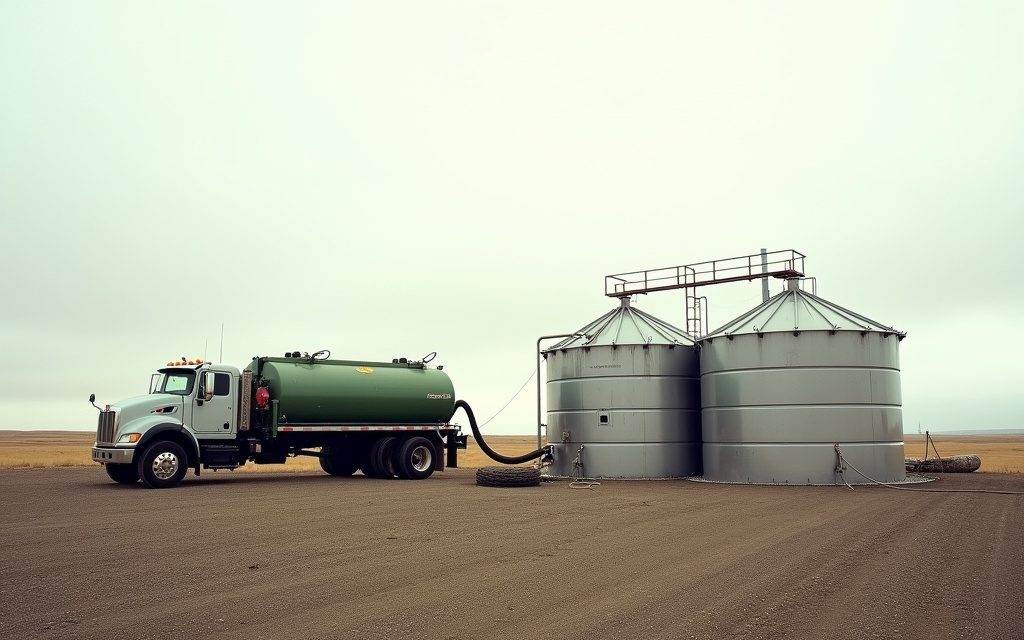
Water handling is an operating cost that produces no revenue, scales with the least valuable thing a well makes, and gets worse every year. Understanding how it is priced is worth doing carefully, because for a large share of Alberta's mature wells it is the number that determines whether the well keeps running.
The water-oil ratio, usually written WOR, is simply the volume of water produced per volume of oil. Related is water cut, the water fraction of total liquid. A WOR of 9 is a water cut of 90 per cent.
A conventional Alberta oil well typically follows a recognisable arc:
The important thing is that this is normal rather than a fault. A rising WOR is what depletion looks like. What matters operationally is whether the revenue from the oil still covers the cost of lifting and disposing of the water that comes with it.
Costs vary with location, competition, volume and the specific facility, so what follows is structure rather than a price list. Anyone quoting you a single provincial number for disposal is guessing.
Trucking is usually the largest component and is the one most sensitive to distance. It is typically charged either hourly for the truck and operator or per load with a distance band. Because it scales with haul distance, proximity to a receiving facility matters a great deal to the economics of a remote property.
Disposal fee at the facility is charged per cubic metre received. It varies with the class of facility, what is in the load, and whether you have a volume arrangement. Clean produced water is at the cheap end; anything requiring special handling costs more.
Pipeline tariff, where a gathering system exists, replaces trucking. The per-cubic-metre cost is dramatically lower than trucking, which is why producers with enough volume build or buy into water gathering systems. The trade-off is capital cost and the regulatory work of building a line.
Lifting cost is easy to overlook because it does not appear on a disposal invoice. Every barrel of water has to be pumped to surface, and that is pump wear, power and workover time. On a rod-pumped well at high water cut, this is real money.
Treating and chemical costs for demulsifier, corrosion and scale inhibitor scale with water volume too.
The rough rule is that trucking is flexible and expensive, pipelines are inflexible and cheap. Trucking needs no capital and can be turned off tomorrow; it suits low volumes, short-life wells and properties where the future is uncertain. A gathering line needs capital, right-of-way and approvals, and is worth it where volumes are high and expected to persist.
The crossover point depends on volume and distance, and it moves with diesel prices and trucking availability. Many operators run a hybrid: piped where the infrastructure exists, trucked from the outlying wells.
A well is shut in when the revenue it generates no longer covers the cost of operating it. At high water cut, water handling dominates that cost, so the calculation usually reduces to a straightforward comparison: does the oil revenue per cubic metre of total fluid exceed the cost of handling that fluid?
This is also why the same well can be uneconomic for one operator and economic for another. A producer with its own disposal well and a gathering system faces a fraction of the water cost of one trucking to a third-party facility, and can keep a well running long past the point where the neighbour shuts theirs in.
There is no typical figure that would be honest to publish. It varies by region, facility, volume commitment, fluid quality and market conditions, and the trucking component swamps the facility fee at any distance. Get current quotes from facilities near you.
Not necessarily. Plenty of Alberta wells have produced economically for years at water cuts above 95 per cent. What matters is the absolute oil rate and the cost of handling the water, not the ratio by itself.
If you have the volume and a suitable formation, usually yes over the long run, and it insulates you from third-party price changes. Against that sits the cost of drilling or converting and completing the well, the approval process, and the ongoing testing, monitoring and reporting obligations. It is a capital decision, not an operating one.
Common causes are a change in fluid characterisation at the receiving facility, a trucking rate change, a facility changing what it will accept, or a nearby facility closing and lengthening everyone's haul. Ask the facility directly; a reputable one will tell you which it is.
Where the water comes up from, what is dissolved in it, and the specific reasons it cannot be put on the ground or into a creek.
Separation, skimming, flotation, filtration and chemical treatment: what gets installed on real leases, and which technologies get talked about more than they get built.
What the well classes mean, what each may legally receive, and why the class printed on a facility's approval decides whether your load gets taken.