Produced Water
What Is Produced Water, and Why Can't It Just Be Released?
Where the water comes up from, what is dissolved in it, and the specific reasons it cannot be put on the ground or into a creek.

Separation, skimming, flotation, filtration and chemical treatment: what gets installed on real leases, and which technologies get talked about more than they get built.
 By Dale Whitcombe · Field Operations Writer & Founding Editor
· Published
· Last updated
· 4 min read
By Dale Whitcombe · Field Operations Writer & Founding Editor
· Published
· Last updated
· 4 min read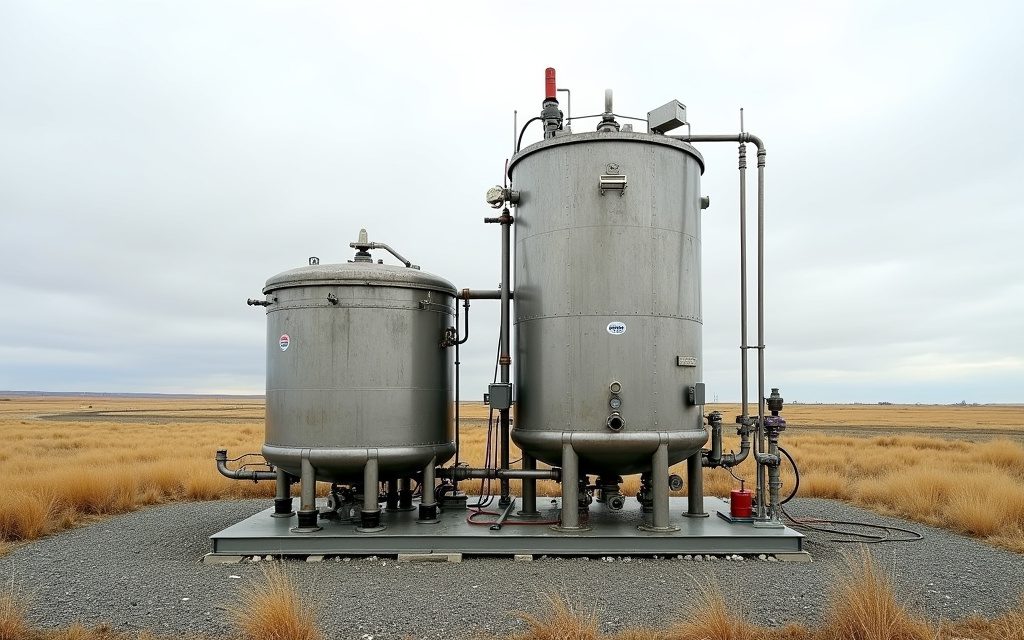
"Treatment" covers a wide range here, from a tank that lets oil float to the top to membrane processes that would not look out of place in a municipal plant. What gets installed depends entirely on what the water is going to do next, and for most Alberta produced water the answer is "go down a disposal well", which sets a much lower bar than reuse would.
This guide runs through what is actually deployed, roughly in order of how common it is.
Before any equipment decision, the question is what the water has to be fit for.
Specifying treatment for a higher standard than the destination requires is one of the more common and expensive mistakes.
This is the foundation and it is on essentially every battery. A three-phase separator takes the well stream and splits it into gas, oil and water using nothing more exotic than residence time and density difference. It is cheap, reliable and has no moving parts to speak of.
What it will not do is remove finely dispersed oil or emulsions. A separator gets the bulk of the free oil out and leaves a water stream still carrying some.
The next stage down the train, giving the water more residence time so additional oil can rise and be skimmed. Simple, effective for what it does, and the performance is almost entirely a function of how much residence time you give it and how well the inlet is designed to avoid short-circuiting.
Many small properties stop here, because the water is going to disposal and this is enough.
Chemistry does a lot of the work that equipment would otherwise have to do:
Chemical programmes are frequently either over- or under-dosed because nobody has tested in a while. It is worth reviewing periodically; both directions cost money.
Where skimming is insufficient, flotation introduces fine gas bubbles that attach to oil droplets and carry them to the surface far faster than buoyancy alone would. It handles dispersed oil that gravity separation leaves behind, and it is common where water is destined for reinjection into a producing formation.
It costs more to run than a skim tank and it needs attention, so it appears where the water quality requirement justifies it.
Media filters, typically sand or walnut shell, remove suspended solids and some residual oil. Walnut shell filters in particular are widely used in produced water service because they tolerate oil that would blind a sand bed. Cartridge filters sit further downstream as polishing.
Filtration is where reinjection water quality is usually finally made, and filter performance is one of the more useful things to trend, because a rising differential pressure tells you something upstream has changed.
Reverse osmosis, thermal distillation, mechanical vapour recompression, electrodialysis and various emerging desalination technologies all appear regularly in conference papers and vendor material. They work. The issue is that removing dissolved salt is energy-intensive, and the resulting concentrated brine still has to be disposed of, so you have spent a lot of money to reduce a volume rather than eliminate a problem.
In a jurisdiction with deep, well-characterised disposal formations and an established disposal industry, the economics rarely favour desalination. They can change where disposal capacity is constrained, where water is scarce enough to have real value, or where regulation restricts disposal. None of those currently describes most of southern Alberta.
Clean enough not to damage the injection formation or plug the well, which in practice means controlling oil in water and suspended solids to whatever the receiving facility or your own well requires. Your facility will tell you its limits; they vary with the formation.
Technically yes, commercially rarely. You would be paying substantial energy costs to produce a smaller volume of much stronger brine that still requires disposal. Unless there is a specific driver, disposal of the whole stream is cheaper.
Often, yes. Rising injection pressure commonly indicates formation plugging from solids, oil carry-over, scale or bacterial products, and the cause is usually upstream of the well. Check filter performance, oil in water, and your biocide programme before assuming the formation is the problem. It can also indicate a well integrity issue, which is a different and more urgent matter.
Sometimes, where there is demand nearby and the chemistry is compatible. It turns a cost into a small revenue and reduces fresh water use. The limiting factors are usually logistics and timing rather than treatment: completions demand large volumes over short windows, and produced water arrives steadily.
Where the water comes up from, what is dissolved in it, and the specific reasons it cannot be put on the ground or into a creek.
Water-oil ratios over a well's life, how disposal pricing is actually structured, and the point at which water handling ends a well's economic life.
What the well classes mean, what each may legally receive, and why the class printed on a facility's approval decides whether your load gets taken.