Disposal Wells
Disposal Well Classes in Alberta, and Why They Matter at the Gate
What the well classes mean, what each may legally receive, and why the class printed on a facility's approval decides whether your load gets taken.

Both push water down a wellbore. One is sweeping oil toward a producer, the other is getting rid of a waste stream, and they are licensed and reported differently.
 By Dale Whitcombe · Field Operations Writer & Founding Editor
· Published
· Last updated
· 4 min read
By Dale Whitcombe · Field Operations Writer & Founding Editor
· Published
· Last updated
· 4 min read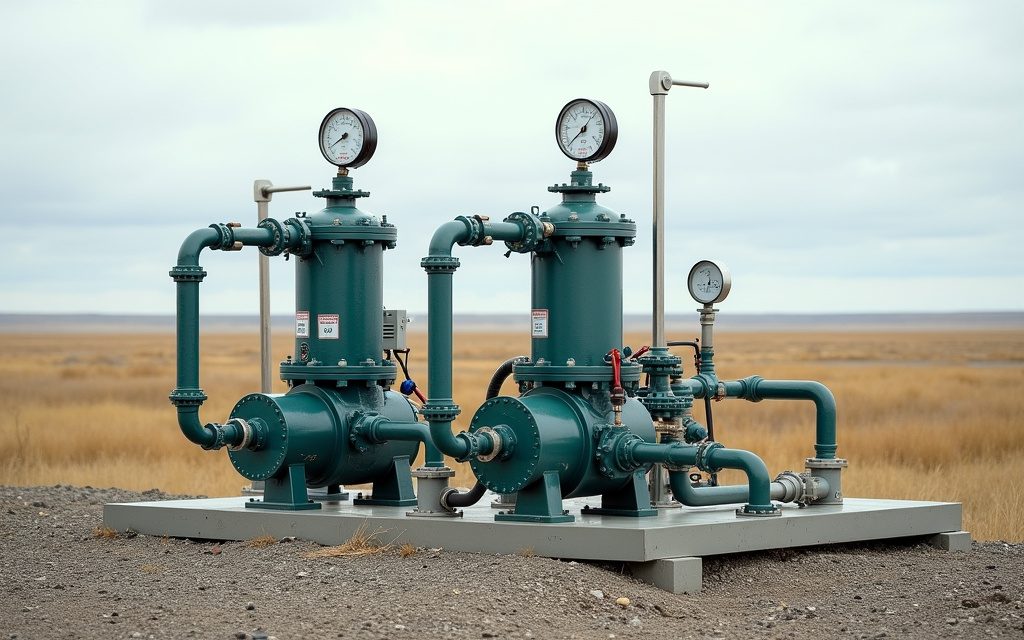
Two wells on the same lease can both be taking water down the hole at similar rates and be doing completely different jobs. One is part of a recovery scheme, trying to push oil toward a producing well. The other is disposal, putting a waste stream somewhere it will stay. The engineering overlaps; the purpose, the licensing and the economics do not.
Operators conflate the two constantly in conversation, and it usually does not matter until it does: when you are filling in reporting, applying for something, or trying to work out why the economics of a scheme look the way they do.
In a waterflood, water is injected into the reservoir through injection wells arranged in a pattern around the producers. The injected water does two things: it maintains reservoir pressure, which keeps the wells flowing or reduces the lift required, and it physically sweeps oil through the pore space toward the producing wells.
The water used is frequently the produced water from the same pool, which is elegant: the water comes up a producer, is separated, and goes back down an injector to help lift more oil. Top-up from another source may be added where produced volumes are insufficient.
The key point is that this water is doing work. It is an input to a recovery scheme with an expected return in incremental oil, and the scheme is designed, modelled and monitored on that basis. Injection rates, pressures and pattern balance are managed to optimise sweep rather than simply to get rid of volume.
Enhanced recovery schemes are approved as schemes, with the pattern, the injection zone and the expected performance all part of the application. The reporting reflects that: injected volumes are tracked against the scheme.
A disposal well has no recovery objective. Its job is to place fluid into a formation where it will remain isolated, permanently. The target is chosen for containment and capacity, not for its relationship to a producing pool. It is commonly a depleted zone or a deep saline aquifer well below any usable groundwater.
The design priorities follow from that. Containment is everything: casing and cement isolating the injection zone, injection through tubing and packer, annulus monitoring, periodic mechanical integrity testing, and an injection pressure limit set below the formation fracture pressure so that the fluid is not pushed into unintended paths.
Disposal wells are classified by what they may receive, which is covered in our disposal well class guide.
| Enhanced recovery injection | Disposal | |
|---|---|---|
| Purpose | Recover additional oil | Permanently place a waste stream |
| Target zone | The producing reservoir | A zone chosen for containment and capacity |
| Success measured by | Incremental oil recovered | Volume placed with containment maintained |
| Water source | Usually produced water from the scheme | Produced water and oilfield fluids, often third-party |
| Economics | An investment against future production | A cost against current production |
| Approval | Approved as a recovery scheme | Licensed and classified for disposal |
Because at the wellhead they look identical. Pumps, a manifold, pressure gauges, a wellhead taking fluid down rather than bringing it up. On a property with both, the same operator checks both on the same round.
The confusion causes real problems in two places. The first is reporting: injected volumes have to be reported against the right well and the right purpose, and getting that wrong creates a discrepancy that has to be corrected later. The second is when someone assumes spare capacity in an injection well can absorb third-party disposal volume. It cannot, unless the well is licensed for it, and treating an enhanced recovery injector as a disposal well is a compliance problem regardless of whether the formation would physically accept the fluid.
Not simultaneously in the ordinary sense, because the purpose, target zone and licensing differ. Wells are sometimes converted from one service to another, but that is an application and a recompletion, not a change of mind.
If it is part of an approved recovery scheme, it is enhanced recovery injection, not disposal, and it is reported as such. If you are simply placing surplus water underground with no recovery objective, that is disposal and needs a well licensed for it. The distinction is the purpose and the approval, not the fluid.
They are not really alternatives. Reinjection into a waterflood serves the scheme and is sized to it; surplus water beyond what the scheme needs still has to go somewhere. Most schemes end up doing both.
Risk relates to injection into or near basement-connected faults, pressure increase and local geology rather than to the label on the well. Both disposal and enhanced recovery injection have been associated with induced events in various jurisdictions. Check whether your area is subject to AER seismic monitoring requirements.
What the well classes mean, what each may legally receive, and why the class printed on a facility's approval decides whether your load gets taken.
Which directives apply to what, how the paperwork chain works from manifest to injection record, and where operators most often come unstuck.
Where the water comes up from, what is dissolved in it, and the specific reasons it cannot be put on the ground or into a creek.